
COMING SOON
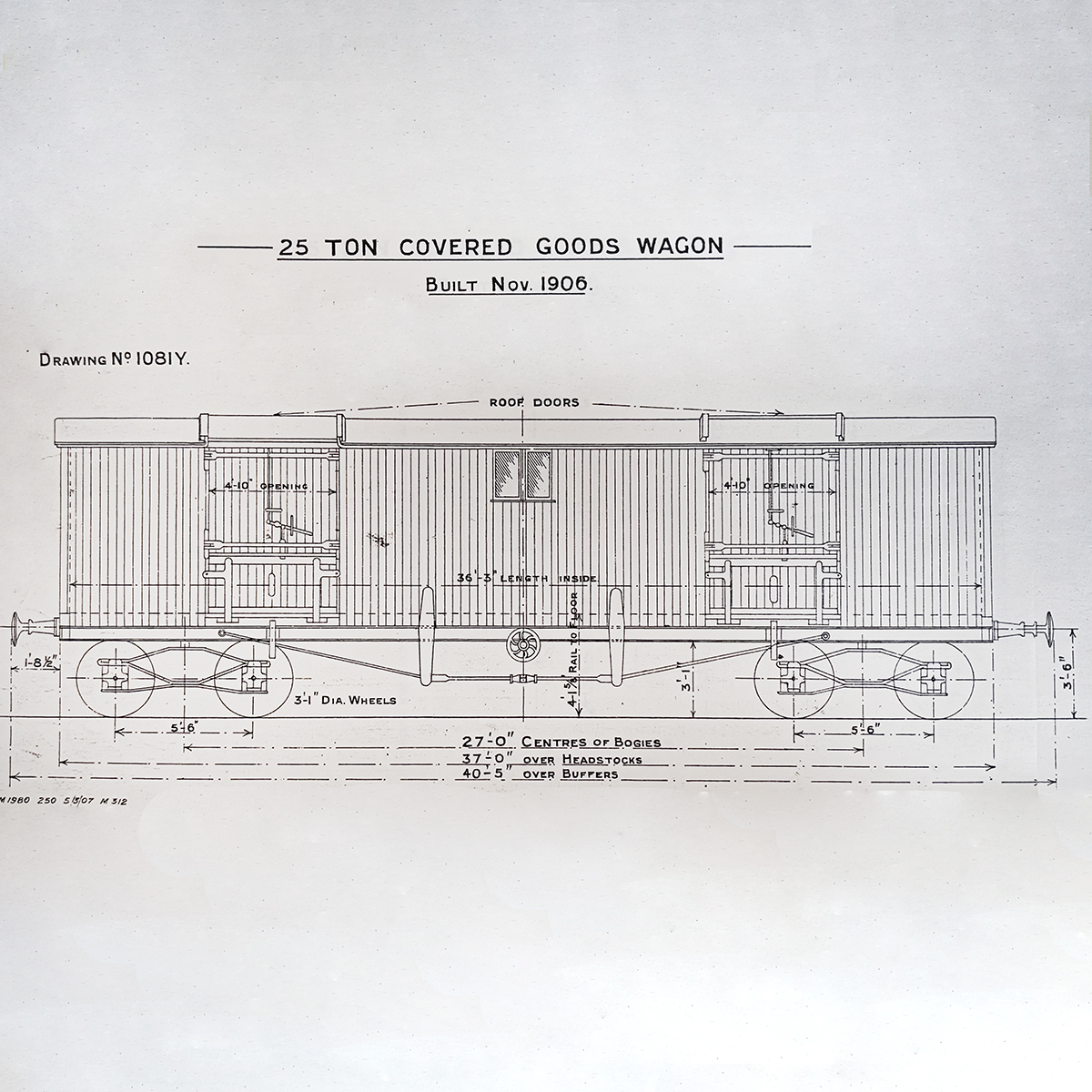
North Eastern Railway Diagram G7 25 Ton Bogie Covered Goods Van. This is offered as a complete kit requiring only your choice of paint and transfers.
A 1:43 scale ‘O’ gauge multi-media kit comprising etched brass body and under frame with precision laser cut quality plywood roof and floor. Lost wax and white metal castings are included with sprung buffers and three link couplings.
See below for further details and prototype information.
0,00 £
Out of stock
In 1906 the North Eastern Railway introduced the first of 100 Diagram G7 25 ton Covered Goods Vans.
These were built by the NER to transfer sundry traffic between tranship stations situated at major goods depots. The original two vehicles built in 1906 had double windows in the centre of each side, the vertical planking of which extended down to cover the sole bars, these features were omitted from the production batch of a further 98 vehicles built between July 1907 and February 1908.
Sliding roof doors were fitted to facilitate crane loading, positioned diagonally opposite on the roof above the left hand door on each side. Vacuum braking was fitted from new with hand brakes being operated by central hand wheels; interestingly they were only piped for Westinghouse brakes most having this removed by the end of 1938. This would indicate that a high percentage of through working off the parent NER system was originally intended. They were constructed and authorised to run at 45-55 mph.
Livery:
These were originally painted in Indian Red (passenger braked vehicle rating), originally with oversize lettering reverting to a standard size after 1910. During the LNER period they were painted Red Oxide. By BR days they were either painted freight stock Brown if having fitted or piped braking or Grey if un-fitted.
All running gear below the sole bar was Black; the canvas roof was painted with White Lead which quickly weathered to Grey / Black.
Sample Allocations and Numbering (Per Wagon Register):
York North Junction Shed
Built Nov 1906
102497, 102497
Built June 1907
106305, 106306, 106307, 106308, 106309, 1, 06311, 106312
Built July 1907
106303, 106304, 106310, 106313, 106314,
Drypool York
Built July 1907
106316, 106317
Built August 1907
106318, 106319, 106320
Built September 1907
106315
Gateshead:
Built August 1907
106321, 106311, 106323, 106324
Newcastle Forth Goods:
Built August 1907
106325, 106326, 106327, 106328, 106329, 106330, 106332, 106333
Built September 1907
106331, 106334, 106341, 106342, 106343, 106344, 106345
Hull:
Built September 1907
106335, 106336, 106337, 106338
Leeds Wellington Street:
Built September 1907
106339, 106340
Contrary to what has sometimes been written the diagram was still complete at the end of 1938 dropping slowly through the war years to 78 vehicles in 1948. After this withdrawal from service was rapid declining to just four vehicles by September 1955, these being 106319, 106330, 106334 and 106339 operational together with 14-15 vehicles in use as static stores vans:
Driffield: 3 vans
106324 to internal user 020231, 106342 to internal user 020232, 106368 no number
Winston: 1 van
Unknown vehicle
Woodburn: 1 van
106364 not renumbered (Photographed in April 1966)
In addition 106387 became DE900194 for the use of the District Civil Engineering Department at York; surviving until at least 1962 in modified form.