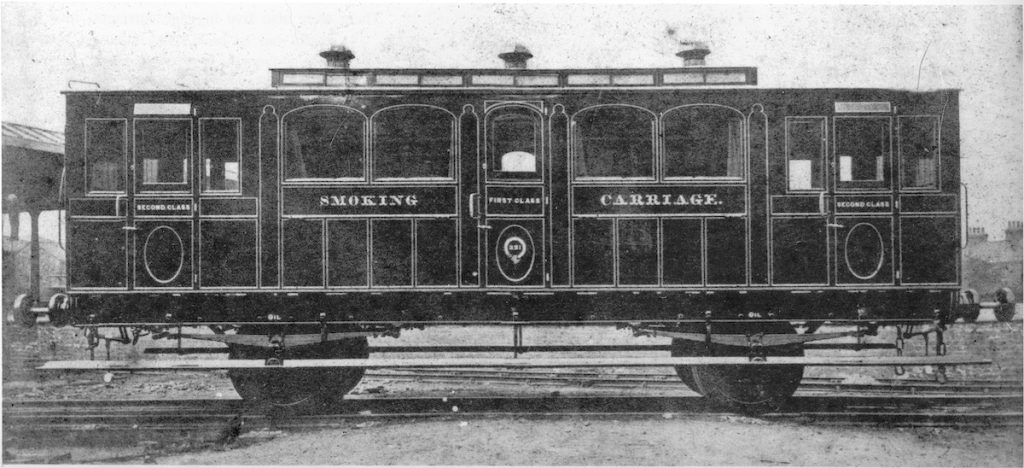
In this image we see a photograph of the Stockton & Darlington Railway Smoking Saloon No.221 probably on its completion in late 1870 / early 1871. The image shows a dark coloured coach with super bright lining . . . but was it?
In the 1860s, colours and shades were much harder to photograph accurately due to the limitations of the chemical process used. The standard wet plate collodion process used at the time was primarily sensitive only to blue and ultraviolet light. This caused a fundamental shift in how colours appeared in black-and-white photos. Blue and purple tones appeared very bright, while warmer colours like red, orange, and yellow appeared unnaturally dark or even black.
This explains why a reflective object like gold leaf on the Smoking Carriage could appear much brighter in the photograph than the teak wood panelling.
HOW SPECIFIC COLOURS APPEARED
- Gold Leaf:Gold leaf is highly reflective and would have appeared very bright or even white in a photograph, especially if light was bouncing directly off its surface. The brightness did not necessarily come from its gold colour, but from its ability to reflect light intensely, particularly blue and UV light.
- Wood:The appearance of wood varied significantly based on its natural colour.
- Light-coloured woodcould appear as a mid-tone grey.
- Reddish or brownish woods, however, would photograph as a very dark grey or black, because the emulsion was largely insensitive to those warmer tones.
- Other colours:
- Blue and blue-green:Collodion emulsion was most sensitive to these colours so they would appear bright white or very light grey in a finished photograph. A clear blue sky contains a large amount of UV light (which easily reflected from gold leaf) would often be rendered as a solid white mass, with little differentiation between it and the white clouds. (This is what we can see here)
- Greens: Most greens appeared dark since it is a mixture of yellow and blue light. Foliage was often rendered as a dark indistinct mass since the chlorophyll in plants absorbs blue light and reflects green. As such trees and grass often appear as dark grey or black. Green liveried locomotives including those of the Stockton & Darlington Railway would therefore be difficult to differentiate to discern.
- Red, orange, and some yellows:These were barely visible to the emulsion and would appear as very dark tones or black. This is famously documented in portrait photography where subjects wearing showy bright red or pink clothing would appear dark in a photo as if they were wearing mourning attire in.
IS IT POSSIBLE TO COORECT THE IMAGE?
It is not possible to correct the spectral sensitivity of an old black-and-white photograph to simulate its original appearance with 100% certainty. The monochrome image retains only the brightness information, and colour data never existed so you cannot simply adjust colour tones in Photoshop. However, with a lot of time patience, it is possible to make an educated guess using digital tools and having a detailed understanding of the chemical processes of the era.
An 1860s wet-plate collodion photograph was primarily sensitive to blue and ultraviolet light. This means that blue objects would appear much brighter than they were, while reds and oranges would appear unnaturally dark. Green colours reflecting different amounts of blue and yellow light sat somewhere in between!
You can go some way to correct this by identifying areas of the image that were blue sensitive and darken them and similarly lightening area that would have been red, orange or yellow. If you can identify these original colours by making an educated guess then you are part of the way there but without actual information it is still an educated guess.
CONCLUSION
Pre-19th century railways are a fascinating area of interest however information is often challenging to find. Photography did not really start until the 1850’s using the collodion process in a very limited way. This photographic process was more sensitive to ultra-violet and blue light than oranges and reds so images appeared differently to today’s true black and white (monochrome) images. This makes the study of such early images confusing and open to error. Researching colour from images should be carried out in conjunction with other original information sources such as paintings, models, artefacts, and even scraping back paint on a locomotive to re